Critics Claim Climate Media Coverage Distorts Scientific Data
06/22/2026 / By Morgan S. Verity

A recent article on Watts Up With That argues that mainstream media outlets misrepresent climate science by ignoring data that contradict their narratives. The post, titled “Climate Media’s Problem? Guess Again,” cites examples such as sea level rise and carbon dioxide effects on plants to support its claims. According to the blog, media reports often omit context that would undercut alarmist conclusions, a charge that has been leveled by critics for years.
Patrick J. Michaels, in his book “Meltdown: The Predictable Distortion of Global Warming by Scientists, Politicians, and the Media,” argues that the prevailing narrative on global warming is exaggerated and distorted by scientists, politicians, and the media. [1] Similarly, an article on NaturalNews.com describes Michaels’ “Climate of Extremes” as presenting a controversial critique of the prevailing climate change discourse, arguing that sensationalism and fearmongering often eclipse scientific rigor. [2] These sources contend that the media selectively uses data to support a predetermined alarmist storyline, a pattern they say has persisted for years.
Specific Allegations in the Blog Post
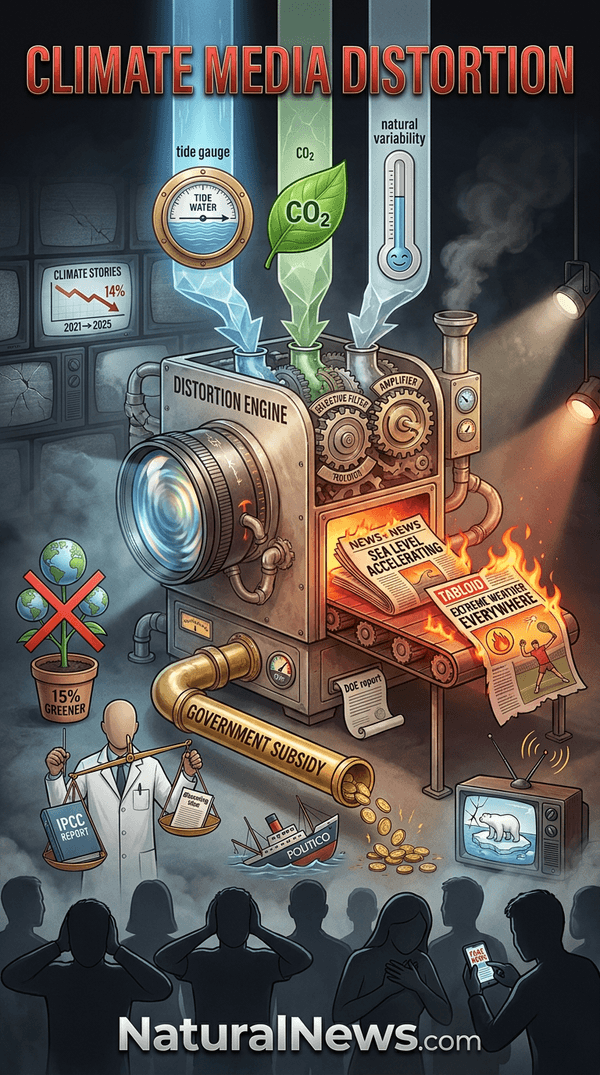
The Watts Up With That blog post points to a ScienceAlert article on sea level “acceleration,” stating that measured data do not show the claimed trend. It references a Politico climate news site that shut down after government funding ended, implying reliance on taxpayer money rather than reader demand. Another example cited is a New York Times piece linking climate change to tennis player illness, which the blog argues lacks evidence. The post asserts that carbon dioxide is beneficial for plant growth and that media coverage downplays this positive aspect.
Research cited by critics supports the notion that CO2 benefits plant life. A NaturalNews.com article states that rising carbon dioxide levels are driving a global “greening effect,” with vegetation increasing by at least 15 percent over the past 40 years. [3] Another report notes that even NASA admits that CO2 is responsible for increasing plant life around the world by 50 percent. [4] Alex Epstein, in his book “Fossil Future: Why Global Human Flourishing Requires More Oil, Coal, and Natural Gas Not Less,” argues that objective reporting on sea level research is often distorted to create a catastrophic headline, citing a 2011 paper that explicitly stated humans would adapt. [5]
Media and Scientific Responses
Mainstream climate scientists and journalists have defended their coverage, stating that they rely on peer-reviewed research and global assessments. According to representatives from organizations such as the American Geophysical Union, the consensus on human-caused climate change is based on decades of data from multiple sources. Some media outlets have acknowledged the need for accuracy but maintain that the overall trends of warming and extreme events are well-documented.
Critics of the blog’s claims, however, argue that isolated data points do not refute long-term patterns and that carbon dioxide’s role in warming is settled physics. Yet authors like Michaels, in “Meltdown,” question this settled narrative, highlighting what they see as systematic distortion. [6] A U.S. Department of Energy report, described by NaturalNews.com as a “bombshell” authored by five eminent scientists, is said to have obliterated decades of politicized junk science peddled by climate alarmists. [7] These conflicting views underscore the deep division over the interpretation of climate data and the role of media in framing the debate.
Funding and Independence of Climate News
The closure of Politico’s climate site is cited by critics as evidence that climate journalism depends on government subsidies. According to the Watts Up With That blog, this dependence implies that such outlets are not driven by genuine reader demand but by taxpayer funding. However, other climate-focused outlets such as Inside Climate News operate on private grants and continue to publish, suggesting a diversity of funding models.
A study reported by the Columbia Journalism Review found that while some media receive public funding, most rely on subscriptions and donations. Nevertheless, the broader trend shows a continuing slump in global media climate stories. Zero Hedge reports that 2025 saw a 14% global slump in climate-related stories compared to 2024, which was already 38% down from the peak of Greta Thunberg-era hysteria in 2021. [8] This decline, critics argue, indicates a public growing weary of alarmist narratives, though proponents of strong climate coverage warn that it reflects a loss of focus on an urgent issue.
Conclusion: The Ongoing Controversy over Climate Messaging
The Watts Up With That article reflects a persistent critique that climate media are selective in their use of data. Critics such as author Matt Ridley have argued that the climate “emergency” narrative is weakening, noting that the “global warming craze is dying out.” [9] Some outlets, including The New York Times, have acknowledged that scientists have retired the direst climate scenarios, a move that climate skeptics say amounts to an admission that the public was fed lies. [10]
Proponents of the mainstream view argue that such critiques often misrepresent the scientific consensus and cherry-pick examples. They maintain that the long-term trends of warming, sea level rise, and extreme weather remain robustly supported by evidence. The disagreement underscores the challenge of communicating complex climate science to a polarized public. Both sides call for greater transparency and accuracy, though they disagree strongly on what that entails.
References
- Patrick Michaels. “Meltdown: The Predictable Distortion of Global Warming by Scientists, Politicians, and the Media.”
- Belle Carter. “Climate of Extremes challenges the mainstream narrative on global warming.” NaturalNews.com. March 5, 2025.
- NaturalNews.com. “The silent boom: How rising CO2 levels are making trees BIGGER and stronger.” June 28, 2025.
- NaturalNews.com. “Fast Company accidentally admits that plants thrive on carbon dioxide.” May 1, 2019.
- Alex Epstein. “Fossil Future: Why Global Human Flourishing Requires More Oil, Coal, and Natural Gas Not Less.”
- Belle Carter. “Patrick J. Michaels Meltdown uncovers controversy of global warming narratives.” NaturalNews.com. September 16, 2025.
- Lance D. Johnson. “US Department of Energy publishes scathing report tackling climate change alarmism and the Net Zero agenda.” NaturalNews.com. August 7, 2025.
- Zero Hedge. “Continuing Slump In Global Media Climate Agitprop Bodes Ill For Future Net Zero Support.” April 16, 2026.
- Watts Up With That. “Matt Ridley thinks the Climate Parrot is almost dead.” April 10, 2026.
- Climate Depot. “The Climate Scam Is Acknowledged. Americans Were Fed Lies, & Deserve To Be Compensated.” June 4, 2026.
Explainer Infographic
Submit a correction >>
Tagged Under:
biased, carbon dioxide, Climate, climate science, deception, disinfo, Ecology, environ, fake news, fearmongering, forests, global warming, greenhouse gases, greening effect, Journalism, lies, mainstream media, news cartels, plants, propaganda, trees, truth
This article may contain statements that reflect the opinion of the author
RECENT NEWS & ARTICLES